
Performance-based marketing is a results-driven model where fees are tied to actual outcomes – like leads, conversions, or sales – rather than just services rendered or hours worked. In other words, you only pay when specified goals are achieved. This guide demystifies performance-based marketing for both aspiring marketing agency owners and business clients, explaining key terminology, service models, pricing structures, real-world examples, pros and cons, and crucial legal considerations.
Table of Contents:
- What Is Performance-Based Marketing?
- Key Terminology in Performance Marketing
- Services Offered in a Performance-Based Model
- Packaging and Pricing Models in Practice
- Pros and Cons of Performance-Based Marketing
- Legal and Contractual Considerations
1. What Is Performance-Based Marketing?
Performance-based marketing (also called pay-for-performance marketing) refers to any marketing arrangement in which the agency or marketer is paid only when a desired action is completed. These actions could be a completed lead form, a sale, a booked appointment, a click, or any KPI defined upfront. Unlike traditional retainers or hourly fees, this model bases compensation on results. It’s essentially akin to hiring a commission-only salesperson, but for marketing services.
In performance marketing, the advertiser’s budget directly links to outcomes – “no results, no invoice”. This approach aligns incentives: the marketing partner wins when the client wins. For example, rather than paying an SEO agency a flat $2,000/month regardless of outcome, a business might agree to pay $100 for each qualified lead generated or a percentage of each sale. On paper, it’s a win-win: the client spends money only on proven ROI, and the agency is rewarded for delivering tangible growth.
However, “pay only when it works” comes with fine print. We’ll explore those nuances – from how agencies structure such deals to potential pitfalls (for instance, agencies chasing easy wins or focusing on short-term metrics at the expense of long-term brand building). First, let’s clarify some common terms you’ll encounter in performance-based marketing.
2. Key Terminology in Performance Marketing
Understanding the lingo is vital for setting up fair, transparent performance deals. Here are some key terms and metrics defined:
- Cost Per Lead (CPL): The cost or fee paid for each lead generated (a lead is often a prospective customer’s contact info or inquiry). In a performance model, an agency might charge a fixed dollar amount per qualified lead delivered. For instance, if CPL is $50, the client pays $50 only when a new lead is brought in.
- Cost Per Acquisition (CPA): The cost per acquired customer or action – often synonymous with cost per conversion. This could mean a cost per sale, signup, or other action that constitutes a customer acquisition. Performance campaigns focused on sales might charge per sale (a CPA model).
- Pay-Per-Lead (PPL): Another way to describe a CPL model – the client pays for each lead provided by the marketer. Many lead generation agencies operate on a PPL basis: e.g. a law firm might pay $100 per lead for each potential client referral.
- Pay-Per-Click (PPC): A common advertising model where you pay for each click on your ad (e.g. Google Ads or Facebook Ads). In context of performance-based arrangements, PPC often refers to paid search or social ads that an agency manages. While PPC itself is a pricing model from ad platforms, agencies might integrate PPC into performance deals by tying their fee to click-based results or conversions from those ads.
- SERP Rankings: Stands for Search Engine Results Page rankings – essentially your website’s position in search results (usually Google). In performance-based SEO contracts, payments might hinge on achieving certain SERP ranking improvements (e.g. top 3 position for a keyword).
- ROAS (Return on Ad Spend): A metric that measures the revenue generated for every dollar spent on ads. It’s typically expressed as a ratio or percentage. For example, a ROAS of 400% (or 4:1) means $4 revenue for each $1 in ad spend. In some performance agreements, agencies might have targets or bonuses based on ROAS – though many P4P deals focus on direct lead/sale counts and bypass intermediate metrics like ROAS in billing.
- Conversion: A generic term for a successful desired action (purchase, lead, signup, etc.) that you’re aiming for. Performance models revolve around driving conversions and only paying for those.
- ROI / Return on Investment: In marketing context, the profit or value gained from campaigns versus cost. Clients engaging in performance-based marketing are looking to maximize ROI by only paying when marketing delivers results.
These terms form the basis of defining goals and payments in any performance-based contract. For instance, a client and agency might agree on a CPL of $20 with an expected volume of 100 leads/month, or a target CPA of $100 for each e-commerce sale. Clarity in terminology is crucial – e.g., specifying what counts as a “qualified lead” or “acquisition” – to ensure both sides measure outcomes the same way.
3. Services Offered in a Performance-Based Model
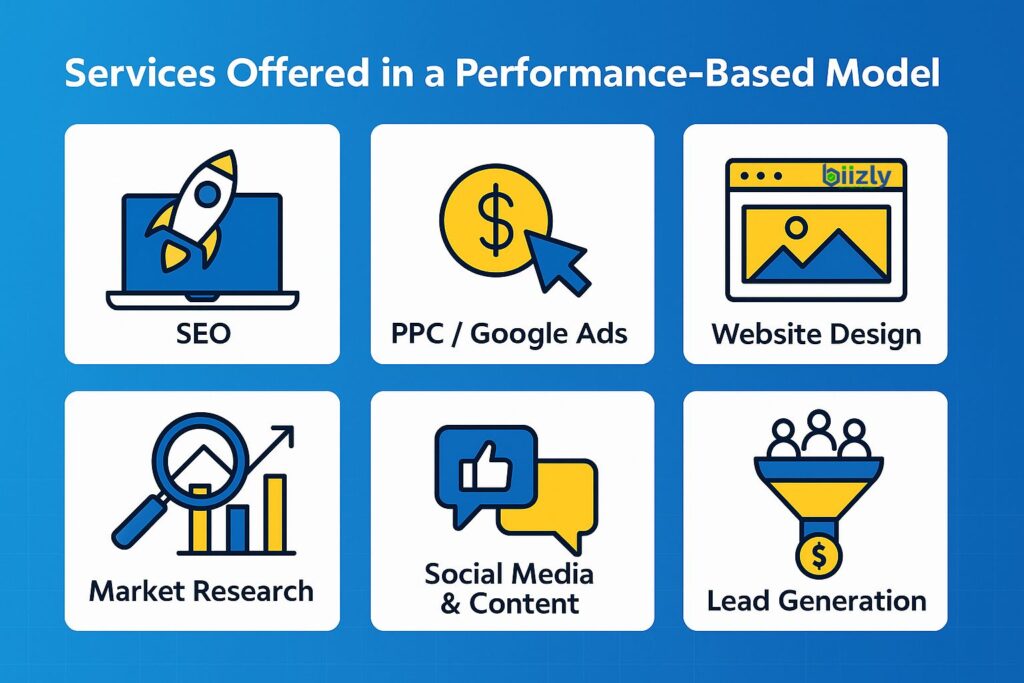
Almost any digital marketing service can be delivered in a performance-tied way, but the structure varies by service. Below we explore how common services are adapted to performance-based arrangements:
SEO (Search Engine Optimization)
Performance-based SEO means the client pays only when certain search performance goals are met – for example, improved keyword rankings, higher organic traffic, or even conversions from organic search. An agency might set up a pay-per-rank deal (e.g. “$X once keyword Y reaches the top 5 on Google”) or pay-per-traffic (“$Y per 1000 new organic visitors”). In theory, this sounds appealing – “pay after we get you to Page 1!” – eliminating upfront risk for the client.
In practice, pay-for-performance SEO is tricky and often discouraged by experts. SEO results are influenced by many variables (site content, competition, Google’s algorithms) and can take months to materialize. Because performance-SEO providers only earn if they hit targets, there’s a temptation to resort to short-term or black-hat tactics to boost rankings quickly. For example, an agency might focus only on a few low-value keywords that are easy to rank for (so they can claim “success” and get paid). They might even use spammy SEO techniques (keyword stuffing, sketchy link schemes) to spike rankings in the short term. This can backfire badly – Google penalties could drop your site from the results entirely, hurting the client’s long-term traffic.
Pros: If structured well, performance SEO can assure you don’t pay unless you gain visibility. It strongly motivates the SEO agency to deliver results. Cons: It can lead to a narrow focus on rankings over quality. Many reputable SEO agencies avoid pure performance deals due to the inherent risks and delayed nature of SEO. Clients should be wary of “too good to be true” promises here. A safer middle-ground some firms use is a hybrid model (small base fee + bonus for each keyword ranked or traffic milestone) to ensure the agency covers costs for sustained, white-hat efforts while still rewarding results.
Pay-Per-Click Advertising (Google Ads & Others)
For Google Ads and other PPC campaigns, performance-based marketing usually means paying for outcomes like leads or sales generated by those ads, rather than a flat management fee. One common model is pay-per-lead in PPC: the client covers the actual ad spend, but the agency’s fee is $X per lead that the campaigns deliver. For example, instead of paying an agency $1,000/month to manage Google Ads, a lawyer might agree to pay $200 per qualified lead (call or form fill) generated via the ads. In a performance-based fee structure, the agency’s earnings scale only with the results, not with hours worked or media budget.
Another variant some agencies use is tying fees to return on ad spend (ROAS) or conversion value. For instance, an e-commerce focused agency could take a percentage of revenue from ad-driven sales (making them essentially an affiliate partner on the ad channel). However, this requires robust tracking and trust. More often, PPC performance deals stick to per-lead or per-sale fees, or a commission on ad spend. (Notably, many agencies charge a percentage of ad spend – say 10-20% – as their fee, which they sometimes call a “performance fee” but it’s really a workload-based scaling fee. True performance compensation is based on results like conversions, not just spend.)
Budget responsibilities: Typically, the client still pays the ad platforms for clicks. The performance fee is separate and paid to the agency for managing the campaigns effectively. In some high-stakes arrangements, an agency might even front the ad spend and essentially sell leads to the client (this is more akin to affiliate marketing). For example, a lead generation specialist might run ads on their own dime (in their own account) and charge the client, say, $100 per lead, often asking the client to pre-pay for a batch of leads. This is a higher-risk, higher-reward model for the agency – if they can acquire leads via ads for $25 each and sell them for $100, they pocket the difference. Agencies like this often require upfront payment (to mitigate risk) and keep their ad tactics and costs opaque to the client.
Pros: Performance-based PPC deals appeal to clients because you pay only for concrete results (e.g. number of leads), simplifying ROI calculations. It pushes agencies to optimize for conversions, not just clicks. Cons: Agencies may cherry-pick what they consider a “lead” or optimize for quantity over quality. If not carefully managed, you might get a lot of low-quality leads that technically meet the criteria. Also, some performance PPC agencies might not be transparent about ad spend and data (since they may run ads in their own accounts), meaning the client could lose insight into campaign performance. Clear agreements on lead quality (e.g. defining target customer criteria) and data sharing are important.
Additionally, note that for social media advertising (Facebook/Instagram Ads, LinkedIn, etc.), similar performance models can apply. An agency might charge per lead or per sale from a Facebook Ads campaign, or a fixed fee per 1000 impressions or engagements – but paying per lead or conversion is most common since it ties directly to business goals. The key is that whatever the channel (Google, Bing, Facebook, etc.), the client and agency agree on which metric triggers payment: clicks, leads, sales, or some proxy metric. Most advertisers care about conversions, so pay-per-conversion is often the go-to if tracking allows.
Website Design and Creation
Surprisingly, even web development can fit into performance-based offers. Some marketing agencies will include website creation “for free” as part of a performance deal to lower the client’s upfront barrier. For example, an agency trying to sign a small business might propose: “We’ll build or redesign your website at no charge, handle your marketing, and you’ll only pay us per lead or as a revenue share from the business generated.” In this model, the agency invests time/money to develop a high-converting website (often because their ability to generate leads/sales hinges on having a decent site or landing pages). The client doesn’t pay for the site development itself – payment comes later through performance fees.
What’s the catch? Usually, if the client terminates the agreement early, there might be a clause about paying for the website’s cost or relinquishing ownership of the site design to the agency. Essentially, the “free website” is an advance investment by the agency to be recouped via future performance earnings. Agencies like Marketing by Ali explicitly bundle free hosting, web design, maintenance, SEO, and ads management as part of their pay-per-lead program. The client gets a modern, optimized site and all the marketing setup without paying upfront. The agency then runs the marketing and “you only pay once you’re talking to a potential customer”. This arrangement is very attractive to cash-strapped small businesses.
For the agency, doing web design on spec is a gamble – they must be confident their marketing will generate results to get paid. Often, they will keep costs down with template designs or reuse frameworks that they know convert well. The website is seen as the “point of entry” for the marketing funnel they will build. Any ongoing costs like hosting or landing page software are generally borne by the agency until performance fees offset them (or they bake those costs into the per-lead price).
Market Research and Strategy
Before any campaign, market research (audience research, keyword research, competitive analysis) is crucial. How is this handled in a performance model? It depends on the agency’s policy and the deal structure:
- Some agencies conduct initial research and strategy development for free or deferred payment, treating it as part of their upfront investment (much like the web design scenario). They’ll absorb the time cost of researching the client’s market, figuring out ad targeting, etc., because they anticipate earning via results later.
- Other agencies might require a small setup fee or base fee explicitly to cover research and campaign setup. For instance, a deal might be structured as “$2,000 initial setup + performance fees thereafter”. This hybrid ensures the agency isn’t out-of-pocket for extensive planning work if the campaign takes time to get off the ground.
- In some cases, especially for larger or more complex projects, an agency might insist on a paid discovery or research phase as a separate contract before a performance-based contract is agreed. This is more common when the client’s industry is highly specialized, meaning the agency can’t accurately predict results without deep research. A compromise could be making the research fee refundable or credited against future performance earnings if certain milestones are hit.
For clients, it’s important to clarify if any upfront research or setup costs exist. Many pure performance deals advertise “No upfront fees at all” (as a selling point), meaning the agency truly does all groundwork at its own risk. Others adopt a “base + bonus” model where the base (maybe lower than a typical retainer) covers baseline activities like research, and the bonuses are tied to performance outcomes. Always define whether things like market research, campaign setup, analytics tool implementation, etc., are included for free or not.
Social Media Marketing & Content
Beyond paid ads, performance marketing can extend to social media management and content marketing, though it’s less straightforward. For example, a social media agency could charge based on engagements or follower growth – e.g. “$X per 1,000 new followers” or a bonus for reaching certain engagement rates. In practice, tying payment to mere likes or shares can be problematic (as those can be vanity metrics). More outcome-oriented is linking social media efforts to leads or site traffic.
A performance-based social campaign might look like: the agency runs a viral contest or organic campaign and is paid $Y for each user who signs up or each demo scheduled via social channels. Similarly, an influencer marketing arrangement might be pure performance – the influencer (or agency managing influencers) gets paid a commission for each sale or lead they drive via tracked links (essentially affiliate marketing).
Content marketing (like blogging or SEO content) typically has longer-term and indirect results, so performance models here might tie to metrics such as organic traffic growth or lead generation attributable to content. For instance, an agency might offer to write content for free and get paid per lead that content generates (tracked via special landing pages or codes). This is less common, but not unheard of in lead-gen focused niches.
Key point: It’s easier to structure performance deals around clearly trackable conversions (clicks, form fills, sales) than around softer metrics. So while an agency may include social media posting or content creation as part of their service, they will tie the compensation to the end results (like traffic or leads from those efforts) rather than each post or share. As Pathlabs notes, in performance campaigns using social media “trackable metrics… are likes, follows, shares, website clicks, or cost per lead” – with leads or conversions being most valuable.
Lead Generation Services (Pay Per Lead and Pay Per Sale)
At the heart of performance-based marketing is lead generation. Entire businesses exist as pay-per-lead agencies: they don’t charge for “campaign management” at all, they simply deliver leads and charge a price per lead. This is common in industries like real estate, legal, insurance, home services, and coaching, where a new customer is valuable and companies are willing to buy leads.
Pay-Per-Lead (PPL) Agencies: These agencies (or networks) run ads, funnels, and campaigns to source leads, then sell those leads to clients. The client might pay, for example, $50 for each exclusive lead (meaning the lead is only sold to them) or a lower price for shared leads (sold to multiple buyers). The pricing often depends on the niche and lead value: legal leads can range from ~$20 up to several hundred dollars each, especially for lucrative areas like personal injury (e.g. personal injury leads often cost $20–$350 each, and auto accident leads $125–$600 each given their high case values). Real estate buyer/seller leads might typically cost $25–$100 each in traditional PPL models. These agencies take on the marketing work and risk; the client just pays per lead delivered.
Pay Per Sale / Commission (Affiliate Model): In some arrangements, especially where leads need to turn into actual sales for real value, the performance deal may be to pay a commission per sale or a percentage of revenue. This is effectively an affiliate marketing model. For instance, a coaching consultant selling a $5,000 program might partner with a marketer who runs webinars and ads for them for free, and then gives the marketer 20% of each sale generated. Real-world example: many e-commerce brands have affiliate programs paying a cut of each sale – when an agency takes on marketing with a pure revenue share, they are acting as a kind of super-affiliate.
In real estate, a notable example is Zillow Flex and similar programs where real estate lead providers only get paid when a transaction closes. Zillow’s program charges around a 35% referral fee on a closed deal (so if an agent closes a $10,000 commission, ~$3,500 goes to Zillow). This is pay-per-sale taken to the extreme: no upfront cost for leads at all; instead, the agent pays a hefty cut on the backend. The logic is that while 35% sounds high, the agent avoids wasting money on dozens of leads that go nowhere – essentially the lead provider shoulders that risk.
Case in point – Law Firms: Many law firm marketing services offer pay-per-lead, but lawyers must mind ethical rules. Marketing companies like Martindale-Nolo or LegalMatch deliver leads in areas like bankruptcy, DUI, personal injury, etc., for a set fee per lead. An example pricing: $100–$500 per lead for exclusive, high-intent legal leads (the ENX2 infographic we retrieved shows typical ranges), with conversion rates perhaps 5–20% from lead to signed client. Law firms value quality – one big case can be worth tens of thousands – so they may prefer paying a premium per lead rather than a flat marketing fee that could yield nothing. The arrangement has to comply with legal ethics (in the U.S., lawyers cannot share fees with non-lawyers, so paying per lead is acceptable whereas paying a percentage of case fees might violate rules if not structured carefully). As such, law firm contracts often specify that the fee is for advertising services and not a referral fee for a specific case.
Case in point – Real Estate: Aside from the pay-at-closing models (35-40% referral fees), simpler PPL deals exist. For example, a lead gen company might sell investor leads at $50 each. A real estate brokerage could also offer an in-house program where their agents get company-provided leads but a portion of commission is deducted on any closing (another hybrid of lead fee and commission). As a client (agent or broker) buying from an external service, you’d compare the economics of paying per lead vs. per closing. According to industry analysis, paying a big referral fee per closing can actually be more cost-effective when you consider the many unproductive leads you’d otherwise pay for under a straight PPL model. In other words, 100 leads at $50 = $5,000, which might yield 2 closed deals, whereas paying 35% of two deals’ commission might be a bit more or less – the best model depends on your conversion rate and cash flow preferences.
Case in point – Coaching and Consulting: Suppose you run an online coaching program charging clients $3,000 for a package. A performance-based agency might offer to generate webinar sign-ups and sales calls for you at, say, $50 per call or 20% of any sales made. This can work if the funnel is short (ad -> webinar -> sales call -> sale) such that the agency’s contributions can be tracked and attributed. Many coaches and course creators work with affiliate marketers or agencies on a rev-share basis because it offloads marketing costs. As DataDab notes, businesses like coaching programs or online subscriptions – basically any with short sales cycles and easily measured funnels – benefit most from P4P models. They can quickly see how many leads -> sales, and scale up what works. If you’re a coach, you’d ensure the contract defines what counts as a referred sale and perhaps have a cap or review period (so you’re not indefinitely sharing revenue with a marketer after their contribution ends).
4. Packaging and Pricing Models in Practice
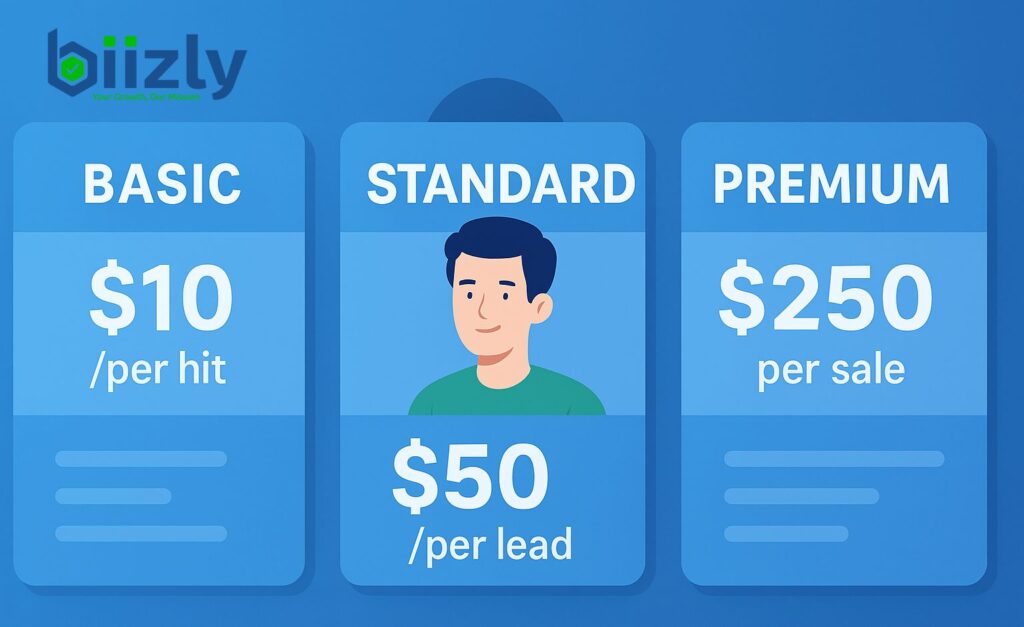
Real agencies structure performance deals in various ways. It’s rarely one-size-fits-all. Here are common performance-based pricing models and package structures:
- Pure Pay-for-Performance: No retainers at all, 100% of agency compensation is via per-result fees or revenue share. For example, an agency might simply charge $20 per lead generated or 15% of each sale made. This model transfers maximum risk to the agency. It’s enticing to clients (“we only pay for results!”), but many agencies will only do this if they are extremely confident in hitting the targets or if the client’s metrics (lead value, conversion rates, etc.) are very favorable. Often seen with lead gen specialists and affiliate marketers.
- Hybrid Model (Base + Performance Bonus): A modest base fee plus performance-based bonuses or commissions. For instance, an agency could charge a small monthly retainer ($1,000) to cover basic costs, and $50 per lead on top of that. Or a marketer might get a baseline fee that keeps the lights on, with an upside of a percentage of revenue if they exceed certain targets. This balances risk: the client shows commitment by paying some base, while the agency still has skin in the game to drive results. Many experienced agencies prefer this approach for new engagements – e.g., “$2,000/month + 10% of any monthly sales over $50k that we generate”.
- Tiered or Milestone-Based Bonuses: The deal includes escalating rewards as performance grows. For example, “If we generate up to 50 leads/month, we get $50 each; 51–100 leads, $60 each; beyond 100, $70 each.” Or, “We get a $5,000 bonus for every 100 sales achieved.” This incentivizes the agency to not just hit the minimum but to scale volume. It also rewards exceptional performance without the client feeling like they overpay for mediocre results – the highest fees only kick in when outcomes are excellent.
- Percentage of Ad Spend (with performance conditions): While a pure percent-of-ad-spend model isn’t performance-based in itself, some packages use a low percent of spend plus a bonus for meeting goals. For instance, “5% of ad spend as base management, plus a 15% bonus on any month where ROAS exceeds 500%.” This ensures the agency covers costs for managing large budgets but only gets the bonus when campaigns are truly profitable.
- Commission on Profit: In some rare cases, agencies and clients may agree to share profit rather than revenue. This requires trust and transparent calculation of profit margins. For example, an e-commerce brand might give a marketing partner X% of net profit from sales that partner drives. This is complex to track and verify, so it’s less common, but it aligns deeply with the client’s bottom line.
- Exclusive vs. Non-Exclusive Leads: In lead gen, pricing will reflect whether leads are exclusive (only sold to one client) or shared among several. Exclusive leads cost more (since that client alone has the chance to close it). Clients should clarify this in any package – paying per lead only to find those leads also went to competitors is not ideal unless it was part of the deal at a lower price.
- Contract Term and Volume Commitments: Some performance deals, especially those run by networks or larger firms, require a minimum commitment – e.g. client will buy at least 100 leads/month for 6 months – or have a lock-in period. For example, real estate referral programs might have 6–24 month contracts with early termination penalties. This ensures the provider has time to recoup their investment. An agency might say, “We’ll do pay per lead, but you need to stick with us for at least 3 months or a minimum of 200 leads.” Aspiring agencies often try to avoid long lock-ins to attract clients, whereas clients might prefer flexibility. It’s a negotiation point.
- Industry-Specific Approaches: Each niche has its own norms. As mentioned, lawyers often pay per lead (with prices tiered by case type); realtors might prefer paying at closing (referral fee); online product sellers might do affiliate links or coupon codes to track sales from an agency campaign. Case studies can illustrate pricing:
- Real Estate: Agency XYZ offers to generate home seller leads via Facebook Ads for $30 each, client must purchase a minimum of 50 leads ($1,500) to start. Alternatively, a brokerage partners with a marketing firm to pay a 20% commission on any closed home sale that came from the firm’s efforts (with clear attribution).
- Law Firm: A legal marketing agency might have a menu: personal injury leads at $200 each (exclusive), family law leads at $50 each (since case values are lower), etc.. The law firm might also pay a higher rate for live-transfer leads (phone calls) versus web form leads.
- Coaching: A marketing agency working for a business coach might take 10% of revenue from each seminar seat or course sold. If the coach sells a $5,000 package to a client that the agency’s campaign brought in, the agency earns $500. If no packages sell, the agency could earn nothing (hence why some will ask for a small base fee to cover ad costs or at least split risk).
Real agencies often have creative mixes of these models. The overarching theme is to find a balance of risk and reward that both client and agency deem fair. If an agency is essentially acting as a partner in your sales, they will price accordingly (higher per-result fees than if you simply paid for service). And if a client demands no risk at all on their side, the agency will make sure the upside justifies it (they might inflate the CPL/CPA fees to hedge their risk).
It’s wise for both sides to run the numbers: compare what a traditional fee would cost versus the pay-per-performance model under various outcome scenarios. For example, a law firm might compare spending $3,000/month on an SEO retainer vs. paying $300 per lead. If the firm typically gets 10 leads/month from SEO, those options break even; if the performance campaign delivers 15 leads, the P4P model is a bargain; if it delivers only 5, the agency makes less and the firm also got fewer leads (but only paid $1,500). This scenario planning helps set realistic expectations and maybe establish minimum performance thresholds.
5. Pros and Cons of Performance-Based Marketing
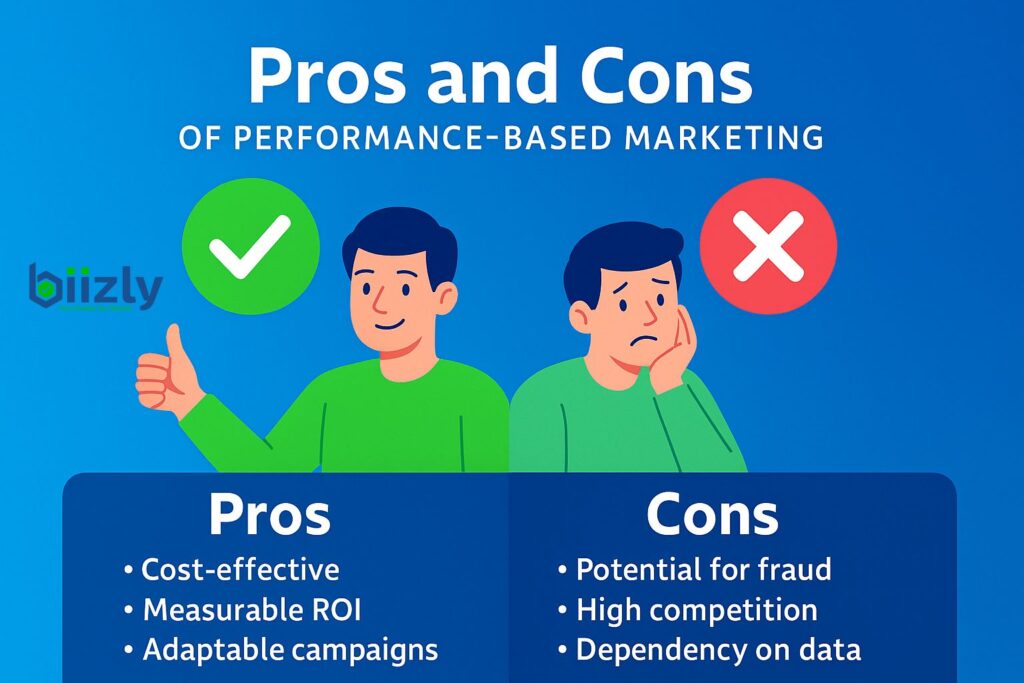
Performance-based arrangements can be powerful, but they come with advantages and disadvantages for both parties. Let’s break down the pros and cons from each perspective:
Advantages for Clients (Businesses)
- Pay for Results, Not Promises: The most obvious benefit – you’re spending marketing dollars only on outcomes that matter (clicks, leads, sales). This greatly reduces the risk of wasting budget on ineffective campaigns. If an agency fails to deliver, you owe little or nothing.
- Cost Predictability and Efficiency: Instead of a nebulous retainer, you often have a clear unit cost per lead or per sale. This makes it easier to forecast ROI. For example, if leads cost $50 each and you need 20 new customers, you know the ballpark spend (depending on your conversion rate from lead to customer). Marketing becomes more like a calculated cost of goods sold than an overhead gamble.
- Aligned Incentives with Agency: In a P4P model, the agency is as motivated as you are to achieve results. Their revenue depends on it. This can lead to a more focused and proactive effort on your campaigns – they’ll “obsess over CAC and ROAS while you build the product,” as one analysis noted. There’s no complacency of just earning a fee regardless of outcome.
- Lower Upfront Investment: Especially for small businesses or startups with limited cash, performance deals let you start marketing without huge upfront fees. You can often get an entire marketing program off the ground (“free” website, ads run, etc.) and pay out of the actual sales that come in. This is very cash-flow friendly and allows trying marketing channels you might otherwise avoid due to cost.
- Expertise on Tap: By engaging an agency on performance terms, you might get access to top-tier marketing skills that you only pay for when they work. It’s akin to having a seasoned marketer working on commission – they might bring creative strategies or optimizations that drive growth, and you’re happy to pay them from the growth.
- Flexibility to Scale: If the model proves ROI-positive, clients can scale campaigns aggressively. Since costs grow in proportion to results, you can confidently ramp up spend – e.g. buying more leads or increasing ad budgets – knowing the returns will scale too. (Do keep an eye on lead quality as volume scales, of course.)
Advantages for Agencies
- Competitive Differentiator: Offering performance-based pricing can help an agency stand out in a crowded market. Clients burnt by past agencies find “pay for performance” very attractive. It can be an effective way for a new agency to win trust – by taking on risk and proving their worth.
- Potential for Higher Rewards: If an agency truly excels at what they do, performance deals can earn them more than flat fees. For example, if you charged $1,000/mo normally, but under a P4P deal you generate 100 leads and earn $20/lead, you’ve made $2,000 that month. Some of the most successful agencies in this space essentially become growth partners and can earn a share of big wins (one huge campaign payoff can dwarf a year of modest retainers).
- Deeper Client Partnerships: These models encourage a partnership mindset. The agency often has to work closely with the client’s sales team or internal processes (because their pay depends on conversions). This can lead to better cooperation, data sharing, and integration, which in turn improves results. The agency might even help the client improve their lead follow-up or landing page conversion, things a typical agency wouldn’t spend as much time on – because now everyone’s incentives are aligned for maximum end-to-end performance.
- Refined Performance Focus: Knowing that only results pay will sharpen the agency’s focus on strategies that drive measurable outcomes. It pushes agencies to be more innovative and efficient with their tactics – using data, optimizing constantly, and cutting anything that doesn’t drive the agreed KPIs. This can enhance the agency’s skill and reputation for delivering real value.
- Long-Term Opportunities: If an agency consistently delivers, performance-based clients tend to stick around and even scale up budgets. It’s essentially proof of value. Such arrangements can turn into multi-year engagements or even new business via referrals (“this agency only charges per sale – and it works!”). Some agencies eventually negotiate partial equity or profit-sharing in a client’s business after proving their impact, which is another growth avenue.
Disadvantages/Challenges for Clients
- Quality vs Quantity Issues: A major concern is that agencies might hit the numbers by sacrificing lead or customer quality. “They only chase low-hanging fruit” is a known pitfall. For instance, if you pay per lead, the agency’s goal is purely to deliver volume – they may not care if those leads are highly qualified or likely to convert for you. You could end up paying for lots of junk leads (e.g. random sign-ups incentivized by giveaways, or irrelevant traffic) that fulfill the letter of the contract but not your business needs. Ensuring quality controls and lead definitions in the contract is critical for this reason.
- Data and Transparency: Some performance marketers hold their cards close. If the agency runs the campaigns on their own accounts or uses proprietary methods, you might get limited visibility into what’s happening. You could receive a spreadsheet of leads each week but not know how they were obtained or see the ad analytics. This “data black box” scenario can be frustrating. It also becomes risky if you part ways – you may not retain any of the data or insights to continue marketing on your own. It’s important to negotiate access to relevant data or at least reporting transparency.
- Short-Term Focus: An agency focused only on immediate KPIs might neglect broader marketing efforts that build brand or long-term customer value. For example, they might avoid doing nurturing email campaigns or content marketing because those don’t produce instant pay-for outcomes, even though such activities could benefit the client long-term. If everything is about this month’s leads, some “slow burn” tactics get sidelined. This could hurt the brand in the long run, as noted: P4P agencies may “deprioritize brand-building efforts that don’t immediately generate clicks or leads”. Clients should be aware that not all marketing that matters can be directly tied to short-term conversions.
- Higher Cost Per Outcome: Paradoxically, while you avoid paying for failure, you might pay more for success. Agencies often pad performance fees to ensure they’re well-compensated for the risk. For example, if your in-house cost per lead is $30, a performance agency might charge $60 per lead – effectively double, because they need margin for their work and to cover the possibility of campaigns that don’t work. Similarly, they might take a hefty revenue share. In some cases, clients realize they paid more via commissions than they would have with a flat fee. As DataDab pointed out, some agencies “over-inflate CPL or CPA costs to hedge their own risk,” so you might pay $250 per demo call when internally you could get them for $80. It’s the trade-off for not paying when results are absent – when results do come, they come at a premium.
- Reliance on External Partner: By tying your marketing entirely to an outside agency’s performance, you as a client might lose some internal capability or control. If the agency decides to drop you (maybe they deem it unprofitable) or if the relationship sours, you could be left high and dry without a marketing machine because you hadn’t built anything in-house. Also, consider the scenario where performance is too good: if you haven’t prepared to handle a surge of leads (e.g. your sales team or fulfillment can’t keep up), that success could turn into a problem. While a good agency will try to align on realistic volumes, it’s something to be mindful of.
- Contractual Lock-ins: Some performance deals may lock you into a term or have conditions that are hard to exit (since the agency might invest a lot upfront). Ensure you’re comfortable with any minimum term and have an out clause if they truly underperform. Otherwise, “no results, no pay” might become “no results, but can’t exit contract easily” in worst cases.
Disadvantages/Challenges for Agencies
- Significant Financial Risk: The agency might invest a lot of time (and even money) with no guarantee of payment. If their campaigns don’t work as expected or take longer to optimize, they could run at a loss. For instance, doing SEO for 6 months with zero pay is a big risk if the rankings haven’t hit the target yet. Agencies must have confidence, and ideally prior data, to predict outcomes – but marketing has uncertainties. A few dud projects can hurt an agency’s cash flow severely.
- Dependency on Client’s Sales Process: Once the agency delivers leads or traffic, conversion can depend on the client’s own sales team or product. If the client has a poor sales process, slow follow-up, or a subpar product, the agency’s efforts might not translate into conversions – and thus no payment. One marketer noted, “if your company has problems tanking the conversion rate, that’s not my problem – I can’t be put in a situation where it becomes my problem”. This is why some agencies avoid pure performance or insist the client fixes their end of the funnel first. It’s a major con: an agency could be sending quality leads that never get closed, and they make nothing despite doing their part well. Close collaboration and clear definition of what counts (e.g. if a lead meets agreed criteria, the agency gets paid regardless of whether the client’s sales rep closes it) can mitigate this, but it’s tricky.
- Cash Flow and Resource Strain: Performance models often mean delayed payment. The agency might incur costs for ads, labor, tools, etc., and only invoice at the end of the month or after a milestone. This requires financial stability to sustain. In extreme PPL cases like the Flexxable model, the agency might even float ad spend on credit hoping the leads perform (though they smartly get paid upfront for leads to cover that). Small agencies have to be careful not to overextend with too many performance clients at once.
- Client Exploitation or Non-Payment: There’s a trust factor. The agency might deliver results and then a client disputes the numbers to avoid paying (“Actually, those 5 sales came from our own sources, not your campaign”). Or a client could terminate early after getting a bunch of essentially free work. Solid contracts and tracking are needed, but enforcement can be an issue especially if the agency is working with far-flung clients. Unfortunately, some agencies have stories of not being paid commissions that were due, leading to wariness of purely handshake performance deals.
- Limited Portfolio for Agency Marketing: If an agency only works on performance deals, in the beginning they might have little to show in terms of revenue (because of ramp-up time) or case studies (because results may be proprietary or took time). It can be a slower build to scale the agency’s own income. Plus, negotiating each deal’s terms can be complex and time-consuming compared to say a standard rate card of services.
- Ethical and Legal Hurdles: In certain industries (like legal, financial, healthcare), the agency has to be careful structuring deals so they aren’t inadvertently engaging in fee-splitting or violations of regulations (more on this next). The agency might have to turn down or modify performance deals in regulated fields, potentially losing business or having to accept a partial-fixed model instead.
In summary, performance-based marketing aligns incentives and can be highly effective, but it demands trust, transparency, and clearly defined expectations to work well. When evaluating such a partnership, both sides should weigh these pros and cons in light of their own situation – e.g., a client’s ability to handle influx of results, or an agency’s ability to survive a slow start.
6. Legal and Contractual Considerations
Because of the unconventional payment structure, it’s critical to nail down the contract details and legal implications of performance-based marketing engagements. Here are key considerations and best practices for agreements:
- Define Performance Metrics and KPIs Clearly: The contract must specify exactly what constitutes a successful action that triggers payment. If it’s leads, define lead qualification criteria (e.g. “contact info from a person within our service area interested in X service”). If it’s sales, define how sales are tracked (e.g. via unique referral links, or a shared CRM). Ambiguity here is a recipe for disputes. For instance, if an e-commerce sale has a return, does the agency still get commission? It should be outlined that only non-refunded sales count, or whatever the agreement is. Attribution rules are crucial: decide how to attribute a customer who may have multiple touchpoints. Multi-touch scenarios can cause conflict (e.g. the agency claims credit for a sale that also came from a client’s email list). Many contracts use “last click” or specific tracking links to attribute, but make sure it’s mutually understood. It can be helpful to integrate the agency’s tracking with the client’s systems where possible, so both see the same data.
- Payment Terms and Schedule: Clarify when and how the agency gets paid for results. Monthly invoicing is common – e.g. at month-end, tally the leads delivered and bill $X times number of leads. Some deals might require the client to preload funds or pay upfront for a block of results (as in some lead gen models where you prepay for 100 leads). If using a revenue share, decide the payout timing (immediately on sale, or perhaps monthly for all sales in the prior period). Ensure the client isn’t holding off payment too long after results are delivered; conversely, agencies might include a clause for auditing or verifying the numbers reported by the client if the data comes from the client’s side.
- Duration and Termination Clauses: Because an agency might invest heavily upfront, contracts often have a minimum term (e.g. 3 or 6 months) or a notice period for termination. However, clients will want the ability to exit if the agency isn’t delivering. A fair approach might be: an initial trial period after which either party can exit, or performance-based early termination fees (for example, if the client quits early, they might pay a predefined fee to cover the agency’s sunk costs, unless the quit is due to gross non-performance). Review any automatic renewal conditions. Also include a clause on how long the agency is entitled to commission on a customer – e.g. if they bring a client who keeps buying every month, do they get a cut of lifetime value or just the first purchase? Typically, it’s safer to tie to the initial conversion unless otherwise agreed.
- Data Ownership and Access: The agreement should state who owns the data (lead lists, ad account data, etc.) and what access the client has during and after the engagement. Ideally, the client should maintain ownership of their customer data – for example, leads generated should belong to the client. If the agency is using their own landing pages or CRM, ensure there’s a mechanism to transfer leads to the client in real-time and also that upon termination the client gets the list of leads delivered. If the agency runs ads in their own account, consider how the client can audit performance. Some agencies might share read-only dashboards or weekly reports. Including a reporting requirement (e.g. weekly or monthly performance report) in the contract helps transparency.
- Lead Quality and Rejection Policy: To avoid conflict, agree on a process for lead quality disputes. For instance, the client may reserve the right to reject leads that are clearly bogus or outside the agreed criteria (and not pay for those). Set a timeframe and reasonability standard for rejections – e.g. “Client must notify Agency of any disqualified leads within 5 business days with reason (e.g., duplicate lead, under 18, etc.). Such leads will be deducted from the bill.” This keeps both sides accountable: the agency tries to filter good leads; the client can’t unfairly refuse to pay for leads after the fact without valid cause.
- Compliance with Laws and Regulations: Performance marketing must still abide by advertising laws and any industry-specific regulations. The contract should stipulate that the agency will follow all relevant laws (like data protection laws for lead generation, truth-in-advertising, etc.). In sensitive industries (legal, financial, healthcare), explicitly address compliance:
- Legal field: The American Bar Association and state bars have rules on lawyer advertising and solicitation. Typically, paying per lead is allowed (it’s considered advertising cost), but paying a percentage of legal fees to a non-lawyer marketer is not (that’s fee-splitting). The contract should clarify that what the client pays is for advertising services, not for referred clients in a way that violates ethics. Disclosure requirements may apply – e.g., the lawyer may need to disclose to clients if an external agency is involved in lead generation on a pay-for-performance basis.
- Real estate: In the U.S., RESPA (Real Estate Settlement Procedures Act) prohibits paying unlicensed individuals based on transaction success (to prevent kickbacks). But referral fees paid through licensed broker-to-broker agreements (like Zillow Flex operates) are legal. If an agency is not a licensed brokerage, they must be careful not to structure it as an undisclosed referral fee. Most likely, a marketing agency in real estate would stick to pay-per-lead or a flat marketing fee, unless they partner with a licensed entity for a rev share. Agents should ensure any pay-per-closing program has proper disclosure and is compliant; contracts might include that the agent’s broker approves the arrangement and that referral fees are disclosed in closing statements if required.
- Health/Finance: Similar issues – e.g., Medicare-related lead generation has strict rules, finance (like mortgage leads) have RESPA and privacy laws, etc. Both parties should warrant that they’ll follow applicable regulations and have indemnities if one side’s actions cause legal trouble.
- Confidentiality and Non-Compete: Since an agency might gain deep insight into the client’s business and the client might see the agency’s methods, mutual NDAs are common. An agency may also be asked not to work for direct competitors in the same locality or niche during the engagement (or a short period after) if they’re essentially partnering closely. For the agency’s part, if they develop specific campaigns or content, clarify ownership – usually, content or creative made for the campaign becomes the client’s property (or at least licensed to them) once paid for via the performance fees.
- Dispute Resolution: Because of the variable nature of payments, it’s wise to have a clause on how disputes are handled. For example, if there’s a disagreement on how many leads were delivered or on whether certain sales were attributable, perhaps the contract sets a path: good faith negotiation, then maybe mediation or arbitration. This can prevent a minor tracking issue from blowing up into litigation.
- Role and Responsibilities: The contract should outline what each party will do. The agency’s duties (e.g. “Agency will design landing pages, manage PPC campaigns, and optimize SEO…”) and the client’s responsibilities (e.g. “Client will promptly follow up on leads, provide necessary product info, and have landing page conversion tracking in place”). It may sound formal, but spelling this out helps. For example, if the client fails to follow up leads for weeks, the agency isn’t blamed for poor conversion. Some agreements include that the client must maintain certain service levels (like call new leads within X minutes) if the model depends on it – as one study noted, responding to leads within 5 minutes vastly improves conversion. While you can’t always enforce that, it sets expectations.
- Exit and Post-Contract Use: If the relationship ends, can the client continue to use the landing pages or ads the agency created? Often the client would want to, since they paid for results that presumably came from those assets. The contract might grant the client ownership of creative assets after a certain amount paid. Alternatively, if the agency provided a website “for free,” there might be a buyout clause for the site if the contract terminates early. Both sides should consider how to unwind amicably: the client shouldn’t lose all marketing momentum, and the agency should receive any due commissions for deals in the pipeline (e.g. if a lead they generated ends up closing after the contract, perhaps there’s a timeframe in which the agency still earns commission).
In summary, clarity is king in performance marketing contracts. Both parties must be on the same page about what’s being measured, how it’s tracked, and who does what. It’s highly recommended to have an attorney review the agreement, ideally one familiar with the specific industry nuances (e.g. real estate or legal marketing rules, as applicable). When done right, a solid contract provides the framework for a trust-based relationship where each side can confidently focus on their work: the agency on driving results and the client on handling the growth.
Conclusion
Performance-based marketing can be a game-changer for both businesses and agencies. It’s a model built on accountability and shared success: agencies only prosper when their clients prosper. By explaining what it is, how common services like SEO, PPC, and web design can be delivered for performance, and examining real-world pricing examples from real estate to law, we’ve seen that there are many ways to structure these deals.
For agencies, stepping into performance-based models requires careful thought – you must control your costs, vet clients (and their sales processes), and possibly take on short-term risk for long-term reward. When successful, it can elevate your reputation and earnings, but be mindful of the pitfalls (like chasing easy metrics or overextending resources). Start with hybrid models or a pilot project to prove value.
For clients, performance-based marketing offers an enticing promise of “paying for outcomes” – just remember to do your due diligence. Work with reputable partners, define quality criteria, and maintain communication. Don’t completely “set and forget” your marketing just because the agency is incentivized; your collaboration and feedback will still be key to success. And be prepared: if the results pour in, ensure you can handle them – a flood of leads is only good if you can convert and service them.
In the end, a well-crafted performance-based arrangement can create a true partnership. The agency is no longer a vendor but a stakeholder in your growth, and the business gains a motivated ally. By understanding the terminology, models, case studies, pros/cons, and legal guardrails presented in this guide, you can approach performance-based marketing with eyes open. When both sides uphold their end – delivering quality work and honoring agreements – performance-based marketing truly lives up to its win-win potential, driving high-ROI campaigns and strong, trust-based relationships.